
Mastering Estimate Review for Developer Accuracy
What you'll learn
 Understanding Estimation FoundationsIdentifying Red Flags in EstimatesTechniques for Deeper AnalysisFostering an Estimation Culture
Accurate project estimates are not merely administrative formalities; they are the bedrock of successful project planning, resource allocation, and stakeholder confidence. For software engineering managers, the ability to properly review developer-provided estimates is a critical skill that directly impacts team productivity, delivery predictability, and ultimately, business outcomes. This guide delves into practical strategies for scrutinizing estimates, identifying common pitfalls, and cultivating an environment where realistic and reliable projections become the norm rather than the exception.
The Foundation of Good Estimates
An accurate estimate is more than just a number; it's a well-reasoned prediction based on a clear understanding of the work, potential challenges, and available resources. Developers often grapple with several factors that contribute to inaccurate estimates, including inherent optimism, a lack of detailed understanding of the task, unforeseen complexities, or even pressure to provide a lower number. Recognizing these underlying influences is the first step toward effective review.
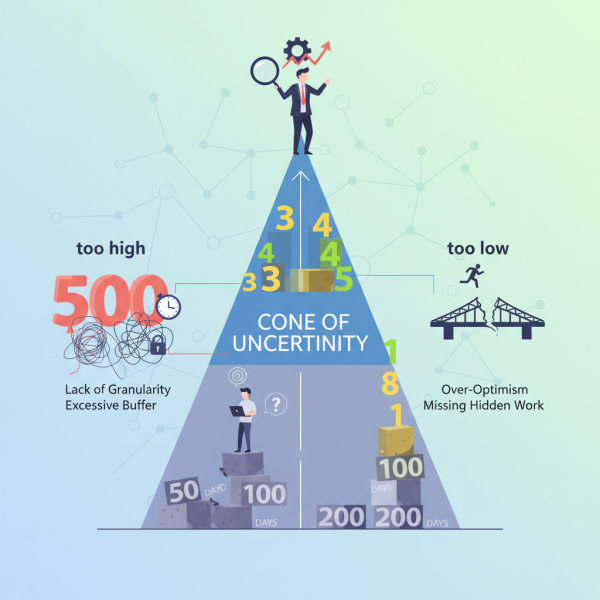
A key concept to remember is the "Cone of Uncertainty." This principle illustrates that at the beginning of a project, estimates are highly uncertain due to a lack of detailed requirements and understanding. As the project progresses and more information becomes available, the cone narrows, and estimates become more precise. Managers should expect wider ranges for early-stage estimates and encourage refinement as clarity improves.
Spotting Red Flags: Identifying Inflated or Inaccurate Estimates
Your role as a manager involves acting as a critical filter, identifying estimates that are either overly optimistic (too low) or excessively padded (too high). Both extremes can derail a project, leading to missed deadlines, budget overruns, or underutilized resources.
Estimates That Are Too High (Potentially Inflated):
- Lack of Granularity: A large, monolithic estimate for a complex feature without a clear breakdown into smaller, manageable tasks. This often indicates a lack of detailed planning or an attempt to hide significant padding.
- Excessive Buffer: When a developer consistently adds an unusually large percentage of buffer time "just in case" without specific risks or uncertainties articulated. While buffers are healthy, excessive ones can be a sign of discomfort or a lack of confidence in the initial assessment.
- Unclear Dependencies: An estimate that implicitly assumes complex external dependencies will resolve themselves or are out of their control, leading to an inflated timeline to cover potential delays without specific actions identified.
- Fear of Commitment: Sometimes, developers inflate estimates out of a fear of missing a deadline or being held accountable for a tight schedule. This is often a symptom of a psychological safety issue within the team culture.
Estimates That Are Too Low (Potentially Inaccurate/Overly Optimistic):
- Over-Optimism: A common human bias, where developers focus solely on the happy path, neglecting potential roadblocks, edge cases, or re-work.
- Missing Hidden Work: Estimates that only account for coding time but overlook crucial non-coding activities such as extensive testing (unit, integration, end-to-end), code reviews, documentation, deployment setup, bug fixing, or collaboration meetings.
- Scope Underestimation: Misinterpreting or underestimating the true scope of a feature, perhaps missing subtle requirements or the implications of integrating with existing complex systems.
- Pressure to Deliver Quickly: If developers feel pressure to provide aggressive timelines, they might subconsciously (or consciously) trim estimates to please, leading to inevitable delays later.
Techniques for Effective Estimate Review
Moving beyond simply accepting or rejecting an estimate, managers need a structured approach to validate and refine them.
Drill Down and Deconstruct:
Request a detailed breakdown of the work. Ask developers to articulate the steps involved, the specific components that need to be built or modified, and any known unknowns. For a task estimated at "5 days," ask, "What are the specific tasks that make up these 5 days? What will you be doing on day 1, day 2, etc.?" This forces a more granular thought process.
Challenge Assumptions (Respectfully):
Identify and discuss the underlying assumptions in the estimate. "You're assuming we'll get immediate access to that API. What if there's a delay?" "You're assuming this component is reusable. Have you verified its compatibility?" By probing assumptions, you uncover hidden risks and potential inaccuracies.
Compare and Cross-Reference:
Leverage historical data. "How long did a similar feature take last quarter?" If similar tasks were estimated and completed by other developers, use those as benchmarks. Cross-reference with other team members if appropriate, perhaps asking for a quick, high-level sanity check without revealing the original estimate. This helps you identify outliers.
Account for Non-Coding Activities:
Remind developers to factor in all aspects of development. This includes setup, environment configuration, code reviews, testing (manual and automated), writing documentation, deployment pipelines, communication overhead, and even unexpected interruptions. Often, these "invisible" tasks can constitute a significant portion of the overall effort.
Focus on Range, Not Point Estimates:
Especially for tasks with high uncertainty, encourage developers to provide estimates as a range (e.g., "3-5 days" or "1-2 weeks") rather than a single point estimate. This acknowledges inherent variability and uncertainty and provides a more realistic expectation.
Utilize Estimation Techniques:
While developers lead the estimation process, managers should understand common techniques like Planning Poker, T-shirt sizing, or the Three-Point Estimating technique (using optimistic, most likely, and pessimistic scenarios). Understanding these methods helps you guide your team towards more robust estimates.
Fostering a Culture of Realistic Estimation
Ultimately, accurate estimates stem from a healthy team culture. As a manager, you are pivotal in shaping this environment.
- Cultivate Psychological Safety: Ensure developers feel safe to provide honest, realistic estimates without fear of negative repercussions for higher numbers. Punishing "over-estimates" will only lead to under-estimates.
- Provide Clear Requirements: Ambiguous or frequently changing requirements are a primary cause of inaccurate estimates. Work with product owners to ensure user stories are well-defined, acceptance criteria are clear, and dependencies are understood before estimation.
- Educate and Coach: Train your team on effective estimation techniques. Share insights from past projects about what led to accurate or inaccurate estimates.
- Conduct Retrospectives on Estimates: Regularly review past estimates against actuals. What went right? What went wrong? What can be learned? This continuous feedback loop is crucial for improvement.
- Celebrate Accuracy Over Speed: Reward teams for delivering predictably and accurately, not just for delivering quickly. This shifts the focus from arbitrary speed targets to reliable execution.
Summary
Effectively reviewing developer estimates is a cornerstone of sound engineering management. It requires a blend of critical thinking, a deep understanding of the development process, and strong interpersonal skills. By understanding the common pitfalls of estimation, employing structured review techniques such as drilling down into details, challenging assumptions, and comparing against historical data, managers can significantly improve the accuracy of project timelines. Furthermore, fostering a culture of psychological safety, clear requirements, and continuous learning will empower developers to provide more realistic estimates, leading to greater project predictability and success. Mastering this skill transforms you from a mere approver of numbers into a strategic partner in your team's delivery excellence.
Comprehension questions
 What are some common pitfalls developers fall into when providing estimates, and how can managers identify them?What is a key strategy for validating a developer's estimate when it seems too high or too low?How can managers encourage a culture of realistic and accurate estimation within their teams?