
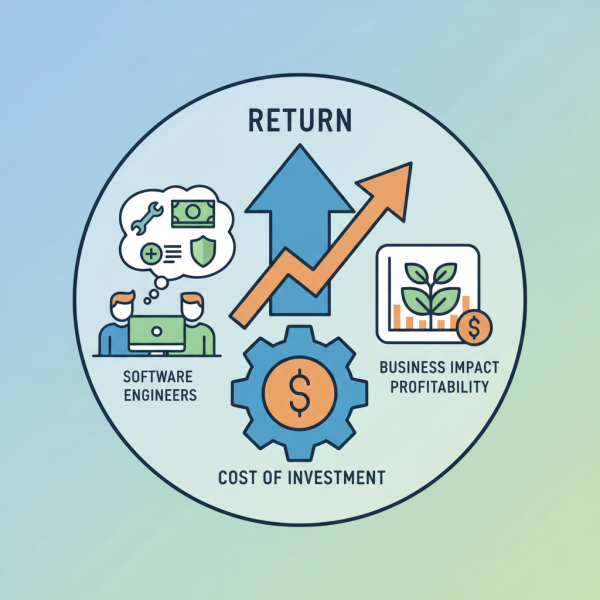
Mastering Return on Investment for Software Engineering Managers
What you'll learn
 Understanding ROIStrategic ImportanceMeasuring Software ROIPractical Applications
In the fast-paced world of software development, where innovation is constant and resources are often stretched thin, understanding the true value of our work is paramount. For Software Engineering Managers, navigating the complexities of project prioritization, resource allocation, and team investments requires more than just technical acumen; it demands a solid grasp of business fundamentals. One of the most critical concepts in this regard is Return on Investment, or ROI. It's a metric that bridges the gap between engineering effort and business impact, providing a clear lens through which to evaluate the efficacy and financial viability of our initiatives.
What is ROI?
ROI, or Return on Investment, is a performance measure used to evaluate the efficiency or profitability of an investment or compare the efficiency of a number of different investments. It directly measures the amount of return on a particular investment, relative to the investment’s cost. To calculate ROI, the benefit (or return) of an investment is divided by the cost of the investment. The result is expressed as a percentage or a ratio.
The basic formula for ROI is:
ROI = (Net Profit from Investment - Cost of Investment) / Cost of Investment
For instance, if a project costs $100,000 and generates $150,000 in net profit (e.g., through increased revenue, cost savings, or efficiency gains), the ROI would be ($150,000 - $100,000) / $100,000 = 0.50 or 50%. A positive ROI indicates that the investment is profitable, while a negative ROI suggests a loss.
Why ROI Matters for Software Engineering Managers
As a Software Engineering Manager, your role extends beyond just managing code and people. You are a strategic partner in the business, responsible for ensuring that your team's efforts contribute meaningfully to the company's goals. Understanding ROI equips you with the language and framework to articulate the value of your team's work to stakeholders, secure resources, and make informed decisions.
Here are key reasons why ROI is indispensable for SEMs:
- Strategic Alignment: ROI helps align engineering efforts with overarching business objectives. By evaluating projects based on their potential return, you can prioritize initiatives that offer the most significant strategic value, ensuring your team is working on what truly matters to the company's bottom line.
- Resource Allocation: Limited budgets, time, and personnel necessitate careful resource allocation. ROI provides a quantitative basis for deciding which projects get funding, which features are developed, and where engineering talent is best deployed, maximizing the impact of every dollar and hour spent.
- Justifying Investments: Whether it's advocating for new tools, hiring more engineers, or investing in technical debt reduction, ROI provides a compelling argument. It translates technical needs into business benefits, making it easier to secure approval from finance, product, and executive leadership.
- Performance Measurement: ROI offers a tangible way to measure the success of your projects and initiatives beyond just "on-time" and "on-budget." It shifts the focus to the actual impact and value delivered, encouraging a results-oriented culture.
- Risk Management: By assessing the potential return versus the investment cost, you can identify high-risk, low-return projects early on, allowing for adjustments or outright cancellation before significant resources are committed.
Measuring ROI in Software Engineering
Measuring ROI in software engineering can be more nuanced than in other departments because "profit" isn't always directly generated by engineering. Often, the returns are indirect, such as increased efficiency, reduced operational costs, improved customer satisfaction, or accelerated time-to-market. Therefore, SEMs need to identify relevant metrics that quantify these benefits.
Consider these metrics when assessing software engineering ROI:
- Cost Savings: Automation tools reducing manual effort, refactoring leading to fewer bugs and lower maintenance costs, or cloud optimization reducing infrastructure spend.
- Revenue Increase: New features attracting more users or increasing conversion rates, performance improvements leading to higher engagement, or faster development cycles bringing products to market quicker.
- Efficiency Gains: Improved development velocity, reduced build times, enhanced deployment frequency, or better collaboration tools. These contribute to faster delivery and lower operational overhead.
- Risk Reduction: Investing in security patches preventing costly breaches, robust testing frameworks minimizing production incidents, or disaster recovery solutions mitigating business disruption.
- Customer Satisfaction/Retention: High-quality software reducing churn, new features increasing user engagement, or improved reliability enhancing brand loyalty. While harder to quantify directly, these eventually translate to revenue.
It’s crucial to establish baseline metrics before an investment and track them consistently after implementation to accurately attribute changes to the project.
Practical Applications of ROI for SEMs
Understanding ROI isn't just theoretical; it has direct, actionable applications in your day-to-day management:
- Project Prioritization: When faced with multiple competing projects, evaluate each one's potential ROI. Which project offers the best return for the investment? This helps in making objective, data-driven decisions rather than relying solely on gut feelings or loudest voices.
- Technical Debt Management: Tech debt is often seen as an invisible cost. By quantifying the productivity loss, increased maintenance, and heightened bug rates caused by technical debt, you can build a strong ROI case for dedicated refactoring or modernization efforts. The "return" here is the avoidance of future costs and gains in future productivity.
- Investing in Team Development: Training programs, certifications, and new development tools might seem like expenses. However, demonstrating how they lead to increased productivity, higher quality code, reduced attrition, or faster feature delivery can prove their positive ROI. A more skilled and engaged team is a more productive team.
- Vendor Selection: When choosing between different software vendors or service providers, don't just compare upfront costs. Factor in the long-term benefits, support, integration capabilities, and potential efficiency gains each option offers to determine the true ROI.
Challenges and Considerations
While invaluable, applying ROI in software engineering isn't without its challenges. Quantifying intangible benefits can be difficult, and long-term returns might not be immediately apparent. It requires a certain level of foresight and the ability to make reasonable estimations. Furthermore, ensure that the metrics you choose are truly attributable to your investment and not influenced by other factors. Transparency in assumptions and calculations is key when presenting your ROI analysis.
Summary
Return on Investment (ROI) is a fundamental business metric that quantifies the efficiency and profitability of an investment. For Software Engineering Managers, understanding and applying ROI is critical for strategic decision-making, effective resource allocation, and justifying the value of engineering initiatives to the broader organization. By focusing on metrics that demonstrate cost savings, revenue increases, efficiency gains, and risk reduction, SEMs can transform their technical work into clear business value. Embracing an ROI mindset empowers managers to not only build great software but also to build a strong, strategically aligned, and financially responsible engineering organization.
Comprehension questions
 What is the basic formula for calculating Return on Investment (ROI)?Name three key reasons why understanding ROI is indispensable for Software Engineering Managers.What are some indirect benefits or metrics that Software Engineering Managers can use to measure ROI, beyond direct profit?How can ROI be practically applied by an SEM when managing technical debt or investing in team development?