
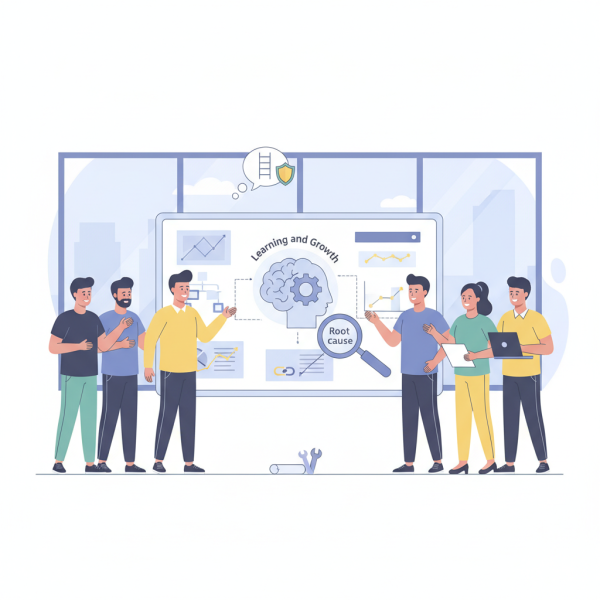
Running Blame Free Post-Mortems as Managers
What you'll learn
 Blameless CultureIncident ManagementMeeting FacilitationSystemic Improvement
Major incidents are an inevitable part of operating complex software systems. While the immediate focus is always on restoration and mitigation, the period immediately following an incident presents a critical opportunity for learning and growth. However, post-mortem meetings can often devolve into a blame game, hindering true understanding and preventing effective systemic improvements. For software engineering managers, the challenge lies in guiding these discussions to be highly effective, data-driven, and devoid of personal blame or high emotion, ensuring that every incident becomes a catalyst for stronger, more resilient systems.
Embracing the Blameless Principle
The cornerstone of an effective post-mortem is the "blameless" principle. This isn't about ignoring mistakes or accountability, but rather shifting the focus from individual fault to systemic weaknesses and process failures. When individuals feel safe to openly discuss their actions and observations without fear of reprisal, a much more comprehensive and accurate picture of the incident emerges.
A blameless culture encourages honesty and transparency. It assumes that everyone involved in an incident acted with the best information and intentions they had at the time. By creating an environment where the goal is collective learning, teams are more likely to uncover the underlying issues rather than just superficial symptoms, leading to more robust solutions.
Thorough Pre-Meeting Preparation
The success of a post-mortem often hinges on the preparation that happens before anyone sits down in a room. Hasty, unprepared meetings quickly become unproductive. Meticulous data gathering and a clear agenda are non-negotiable.
- Data Collection: Before the meeting, compile all relevant data. This includes incident timelines from monitoring systems, logs, metrics, chat transcripts, and any internal communication related to the incident. Organize this information chronologically and make it accessible to all participants.
- Define Scope and Impact: Clearly articulate the incident's boundaries, its duration, and its impact on users, business, and other systems. This ensures everyone understands the magnitude of what occurred and helps keep the discussion focused.
- Participant Selection: Invite key individuals directly involved in the incident, including those who detected, responded, mitigated, or were impacted. A smaller, focused group is often more productive than a large assembly. Ensure a neutral facilitator is designated.
- Set Expectations: Communicate the meeting's purpose in advance: to understand "what happened," "why it happened," and "how to prevent recurrence," not "who is to blame." Reiterate the blameless principle.
Structuring for Objective Analysis
A structured approach helps maintain focus on facts and prevents the discussion from veering into unproductive tangents or emotional debates. The meeting itself should follow a clear, predictable flow.
Begin with a brief recap of the incident's timeline, presented factually and chronologically. This aligns everyone's understanding of the sequence of events. Avoid speculation at this stage; stick strictly to observable data. The facilitator should guide participants through the timeline, allowing for clarification and additional factual input.
Once the timeline is established, move into root cause analysis. Techniques like the "5 Whys" are effective in drilling down past immediate causes to uncover deeper systemic issues. Instead of asking "Who pushed the faulty code?", ask "Why was faulty code deployed?" and then "Why did our CI/CD not catch it?" This iterative questioning helps expose breakdowns in processes, tools, or communication rather than individual errors.
The goal is to identify multiple contributing factors, not a single "smoking gun." Complex incidents rarely have one cause. Focus on interdependencies and cascading failures. Document each contributing factor clearly.
Managing Emotions and Fostering Constructive Dialogue
Even with preparation and structure, emotions can surface. It's the facilitator's role to manage these situations adeptly to ensure the meeting remains productive and respectful.
- Establish Ground Rules: At the outset, explicitly state rules for respectful communication, active listening, and focusing on the problem, not the person. Remind everyone that the goal is collective improvement.
- Focus on Facts, Not Feelings: When discussions become emotional, gently steer participants back to the data, the timeline, and the observed events. Ask "What did we observe?" or "What does the data show?" rather than "How did you feel about that?".
- Use a "Parking Lot": Create a designated space (e.g., a whiteboard section) for topics that are important but outside the current scope or highly emotional. Promise to revisit these topics later or in a separate discussion, ensuring they are acknowledged without derailing the main objective.
- De-escalation: If tension rises, the facilitator should rephrase contentious statements into neutral questions, highlight areas of agreement, and remind everyone of the shared goal: preventing future incidents. Sometimes a short break can help reset the emotional tone.
Actionable Outcomes and Continuous Improvement
A post-mortem meeting is only truly effective if it leads to tangible, actionable outcomes. The discussion should culminate in a set of clear recommendations and assigned responsibilities.
Each action item should be SMART: Specific, Measurable, Achievable, Relevant, and Time-bound. Assign clear owners for each action item and establish a mechanism for tracking progress. The actions should address the identified root causes and contributing factors, aiming to prevent recurrence or mitigate impact.
The post-mortem report itself should be a concise summary of the incident timeline, contributing factors, lessons learned, and, crucially, the agreed-upon action items. This report should be shared widely within the relevant teams to propagate knowledge and reinforce the culture of learning.
Periodically review the status of action items to ensure they are being addressed. This follow-through reinforces the importance of the post-mortem process and builds trust that identified issues will be resolved. Embrace a cycle of continuous improvement where each incident, regardless of its severity, contributes to a more robust and resilient engineering organization.
Summary
Running effective, emotion-free post-mortem meetings is a critical skill for software engineering managers, transforming incidents from setbacks into opportunities for significant organizational learning. By diligently applying the blameless principle, conducting thorough pre-meeting preparation, structuring discussions around objective facts, and skillfully managing emotional responses, teams can uncover deep systemic issues. The ultimate goal is to generate concrete, actionable improvements that foster a culture of continuous learning and build more resilient software systems, moving beyond blame to collective advancement.
Comprehension questions
 List three key activities involved in thorough pre-meeting preparation for a post-mortem.How can a facilitator manage emotional discussions during a post-mortem to keep the meeting objective and productive?What does it mean for action items to be SMART, and why is this important for post-mortem outcomes?