
Scaled Agile Frameworks: Navigating Enterprise Agility
What you'll learn
 Enterprise AgilityScaled Agile FrameworksSAFe PrinciplesLeSS Principles
As Software Engineering Managers, we constantly seek methods to enhance efficiency, predictability, and quality in our development processes. While individual agile teams have proven highly effective, scaling these practices across multiple teams and large organizational structures presents unique challenges. This is where Scaled Agile Frameworks come into play, offering structured approaches to align numerous agile teams toward common business objectives and deliver value at an enterprise level.
Why Scale Agile?
Traditional agile methodologies, designed for small, co-located teams, often struggle when applied directly to large product development efforts involving hundreds or even thousands of individuals. The complexities multiply with increased team dependencies, diverse stakeholder requirements, and the need for synchronized releases across multiple components. Simply adopting Scrum for every team rarely results in holistic enterprise agility.
The primary motivations for scaling agile include:
- Achieving better alignment of development efforts with strategic business goals.
- Improving cross-team communication and collaboration, reducing silos.
- Enhancing visibility into the progress of large, complex initiatives.
- Accelerating time to market for large-scale products and services.
- Managing dependencies effectively across numerous teams and components.
What are Scaled Agile Frameworks?
Scaled Agile Frameworks (SAFs) provide prescriptive guidance and organizational patterns for applying lean-agile principles and practices at scale. They offer a blueprint for structuring teams, defining roles, establishing ceremonies, and managing backlogs across multiple teams, programs, and portfolios. These frameworks help organizations maintain the benefits of agility while navigating the inherent complexities of large-scale software development.
Exploring the Scaled Agile Framework (SAFe)
The Scaled Agile Framework (SAFe) is one of the most widely adopted frameworks for scaling agile. It provides a comprehensive, publicly available knowledge base of proven success patterns for implementing Lean-Agile development at enterprise scale. SAFe emphasizes alignment, collaboration, and delivery across large numbers of agile teams.
SAFe's Core Principles
SAFe is built upon nine foundational principles derived from Lean thinking, Agile development, and systems thinking. Key principles include:
- Take an economic view: Focus on delivering continuous value.
- Apply systems thinking: Optimize the entire value stream, not just components.
- Assume variability; preserve options: Maintain flexibility in planning and execution.
- Build incrementally with fast, integrated learning cycles: Reduce risk and accelerate learning.
- Base milestones on objective evaluation of working systems: Ensure value delivery.
SAFe's Organizational Structure
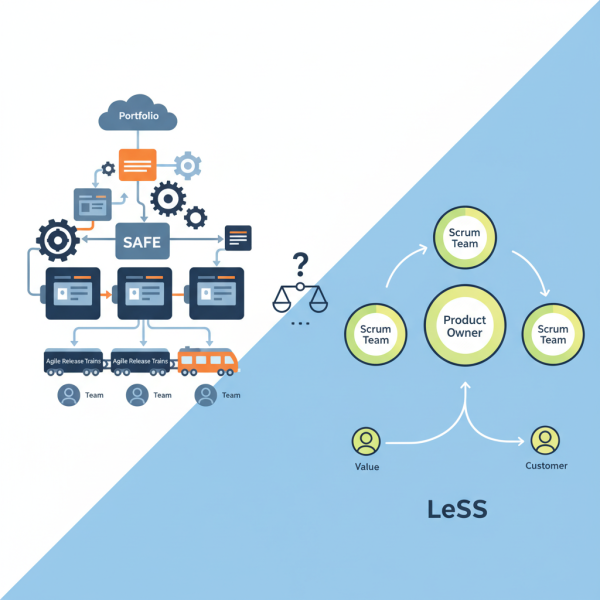
SAFe organizes teams into an 'Agile Release Train' (ART), which is a long-lived team of agile teams (5-12 teams, 50-125 people) that, together with other stakeholders, incrementally develops, delivers, and often operates one or more solutions in a value stream. Above the ARTs, 'Solution Trains' coordinate multiple ARTs for larger, more complex solutions. At the highest level, the 'Portfolio' provides strategic guidance and funding for value streams and their ARTs, ensuring alignment with enterprise objectives.
Key roles in SAFe include Product Owners, Scrum Masters, Release Train Engineers (RTEs), Solution Managers, and Portfolio Managers, each with distinct responsibilities in facilitating flow and managing value delivery at their respective levels.
Understanding Large-Scale Scrum (LeSS)
Large-Scale Scrum (LeSS) is another prominent framework for scaling agile, but it takes a more minimalist approach than SAFe. LeSS emphasizes scaling Scrum itself, rather than adding layers on top of it. It aims to apply Scrum principles and rules directly to large product development, maintaining the integrity of Scrum while expanding its reach.
LeSS Principles
LeSS is guided by a set of principles that underscore its minimalist and whole-product focus. These include:
- Lean Thinking: Eliminating waste and focusing on value.
- Scrum at Scale: Applying Scrum's essence to multiple teams.
- Whole Product Focus: A single Product Owner for the entire product.
- Customer Centric: Delivering value directly to the customer.
- More with LeSS: Achieving greater agility with less complexity.
LeSS Organizational Structure
In LeSS, there is typically one Product Owner for the entire product, regardless of the number of teams. Multiple Scrum Teams (known as 'feature teams') work from a single, prioritized Product Backlog. This structure promotes a whole-product view and minimizes dependencies by encouraging teams to take on complete, end-to-end features. LeSS can be implemented in two configurations: "LeSS" for 2-8 teams and "LeSS Huge" for 8+ teams, both striving to keep the organizational overhead as low as possible while adhering closely to core Scrum principles.
LeSS promotes direct communication between teams and stakeholders, relying on self-organizing teams to coordinate their work within a synchronized sprint cycle. The focus is on simplifying the organizational design to avoid unnecessary roles and processes that can slow down large-scale development.
Choosing the Right Framework
The decision to adopt SAFe, LeSS, or another scaled agile framework depends heavily on an organization's specific context. Factors such as company size, existing culture, regulatory environment, and the complexity of the products being developed all play a crucial role. SAFe often appeals to large enterprises needing a comprehensive, prescriptive roadmap for transformation, while LeSS is often preferred by organizations seeking a lighter touch that closely adheres to pure Scrum principles, focusing on feature teams and a single Product Owner.
Summary
Scaled Agile Frameworks are essential tools for Software Engineering Managers navigating the complexities of large-scale software development. Frameworks like SAFe offer extensive guidance and structure, while LeSS champions a minimalist approach that scales Scrum directly. Understanding their core principles, structures, and applications enables managers to make informed decisions about implementing enterprise-level agility, ultimately leading to improved alignment, faster delivery, and greater business value.
Comprehension questions
 What is the primary challenge that Scaled Agile Frameworks aim to address in large organizations?Name two key differentiators between SAFe and LeSS in terms of their approach to scaling agile.How does SAFe structure teams and programs to facilitate large-scale development?What is the role of 'feature teams' in the LeSS framework?