Communication Strategies for Software Engineering Managers
- -->> 1. Communication Strategies for Software Engineering Managers
What you'll learn
 Multidirectional CommunicationCommon SEM ChallengesEffective Communication StrategiesImpact of Communication
Software Engineering Managers (SEMs) occupy a pivotal role that extends far beyond technical oversight. A significant, often understated, aspect of their daily responsibilities revolves around navigating a complex communication landscape. Unlike individual contributors, SEMs are constantly engaged in multidirectional communication, balancing the needs of their direct reports, cross-functional teams, senior leadership, and external stakeholders. This unique position brings with it a distinct set of demands and challenges that, if not managed effectively, can significantly impact team morale, project timelines, and overall organizational success.
The Multidirectional Nature of SEM Communication
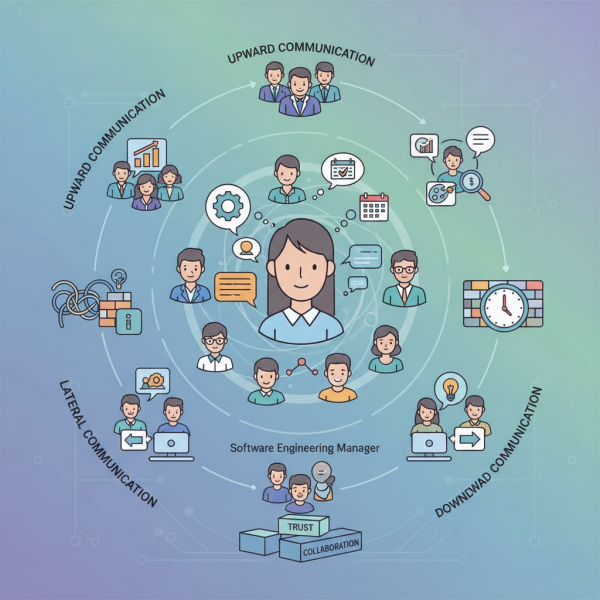
Software Engineering Managers are at the nexus of information flow, acting as conduits and translators across various organizational levels. Their communication responsibilities are inherently multidirectional, requiring them to adapt their style, tone, and content based on their audience. Upward communication involves articulating team progress, challenges, and resource needs to senior management, often requiring a strategic, summary-focused approach. Downward communication, conversely, focuses on disseminating organizational goals, strategic decisions, and feedback to their engineering teams, necessitating clarity, empathy, and motivation.
Lateral communication is equally crucial, involving collaboration with product managers, UX designers, quality assurance leads, and other engineering teams. This horizontal exchange is vital for aligning on dependencies, negotiating priorities, and ensuring seamless integration across different components of a project. Each direction presents its own set of expectations and potential pitfalls, demanding a high degree of emotional intelligence and adaptability from the SEM.
Key Communication Challenges Faced by SEMs
The complexity of SEM communication gives rise to several persistent challenges. These often stem from the diverse backgrounds and priorities of the people they interact with, as well as the inherent pressures of software development.
- Information Overload: SEMs are often deluged with information from multiple sources – project updates, strategic directives, team feedback, technical issues. Distilling this into actionable insights for different audiences without losing critical detail is a constant struggle.
- Balancing Transparency and Confidentiality: Knowing what information can and should be shared with the team, versus what must remain confidential (e.g., sensitive company decisions, individual performance issues), requires careful judgment.
- Conflict Resolution: Mediating disputes within the team, between team members and other departments, or even handling disagreements with senior leadership, demands strong negotiation and de-escalation skills.
- Technical vs. Business Language: Bridging the gap between highly technical discussions with engineers and high-level business objectives with non-technical stakeholders requires the ability to translate complex concepts into understandable terms for each audience.
- Remote and Hybrid Team Dynamics: Managing communication across different time zones, cultures, and communication preferences in distributed or hybrid teams adds layers of complexity, making casual interactions and informal feedback more difficult.
- Feedback Delivery: Providing constructive feedback to engineers, especially when it involves performance improvement or behavioral changes, requires tact, clarity, and a focus on growth.
Strategies for Effective SEM Communication
To navigate these challenges successfully, SEMs must proactively develop and refine a robust set of communication strategies. These go beyond simply talking and listening; they involve intentional effort and continuous learning.
- Active Listening: Truly understanding the underlying concerns and messages from team members, peers, and leadership is fundamental. This means listening to comprehend, not just to respond.
- Clarity and Conciseness: Especially for upward and lateral communication, messages should be clear, concise, and to the point, respecting the time of busy stakeholders. For downward communication, clarity helps prevent misunderstandings and ensures alignment.
- Regular, Structured Check-ins: Implementing regular one-on-ones with team members, stand-ups, and project syncs creates predictable channels for information exchange and problem-solving.
- Leveraging Communication Tools Wisely: Understanding the appropriate use for different tools – Slack for quick questions, email for formal announcements, video calls for complex discussions – is key to efficient communication.
- Empathy and Emotional Intelligence: Recognizing and responding to the emotional states of others, understanding their perspectives, and communicating with genuine empathy fosters trust and strengthens relationships.
- Setting Clear Expectations: Explicitly communicating project goals, individual responsibilities, and performance standards helps mitigate misunderstandings and provides a clear framework for the team.
The Impact of Poor Communication
The repercussions of ineffective communication for an SEM can be far-reaching and detrimental. Misunderstandings can lead to costly reworks, missed deadlines, and a decline in product quality. Low morale and high turnover rates within engineering teams often correlate with a lack of clear direction or insufficient feedback from leadership. Furthermore, a breakdown in communication with stakeholders can result in misaligned expectations, budget overruns, and a loss of confidence in the engineering department's ability to deliver. Ultimately, the success of a software engineering team and the manager's own effectiveness are inextricably linked to their communication prowess.
Conclusion
Understanding and mastering the unique communication landscape is not merely a desirable trait for Software Engineering Managers; it is an absolute necessity. From navigating complex multidirectional information flows to mediating conflicts and translating technical jargon, SEMs face an array of communication demands daily. By adopting strategies centered on active listening, clarity, empathy, and leveraging appropriate tools, SEMs can transform potential pitfalls into opportunities for building stronger teams, fostering collaboration, and driving successful outcomes. Effective communication truly underpins the bedrock of high-performing software engineering teams.
Comprehension questions
 What are the three main directions of communication for a Software Engineering Manager?List three common communication challenges faced by Software Engineering Managers.Describe at least three strategies an SEM can employ for more effective communication.How does poor communication impact a software engineering team and its projects?
Review Quiz
Next Lesson

Course Contents : Mastering Communication for Software Engineering Managers
- >> 1.
 Communication Strategies for Software Engineering Managers