Mastering Verbal Delivery
- -->> 5. Mastering Verbal Delivery
What you'll learn
 Voice ModulationPacing and RhythmClear ArticulationImpactful Pauses
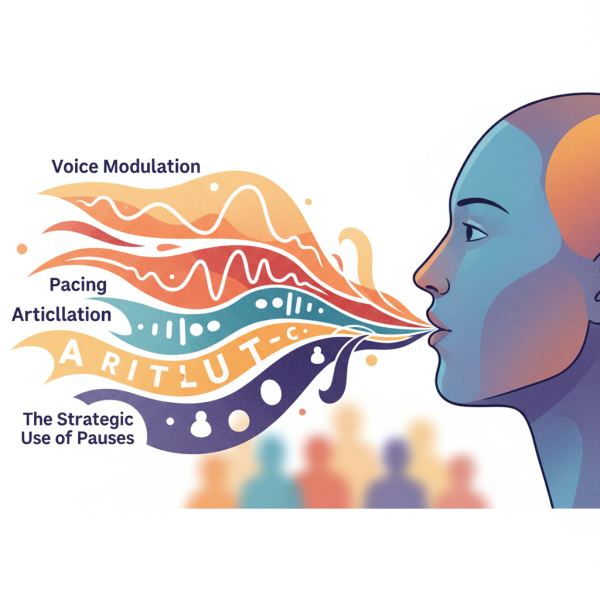
It's not just about what you say, but how you say it. Mastering verbal delivery involves a nuanced interplay of voice modulation, controlled pacing, clear articulation, and the strategic use of pauses. These elements, when skillfully employed, can transform an ordinary message into a powerful and memorable address, captivating an audience and ensuring your message resonates deeply.
Voice Modulation: The Power of Pitch and Volume
Your voice is a versatile instrument capable of conveying a wide range of emotions and emphasizing key points. Voice modulation involves consciously altering your pitch and volume to enhance your message.
Varying your pitch can prevent your speech from sounding monotonous. Raising your pitch slightly for questions or excitement, and lowering it for gravitas or serious points, adds dynamic interest. This keeps listeners engaged and helps them identify the most important parts of your message without explicitly being told.
Similarly, adjusting your volume is crucial. Speaking louder can draw attention to a critical statement, while a softer, more intimate tone can create a sense of confidentiality or personal connection. Remember that volume should always be appropriate for the setting, ensuring everyone can hear you comfortably without being overwhelmed.
Pacing: The Rhythm of Your Message
Pacing refers to the speed at which you speak. An optimal pace ensures clarity and comprehension, preventing your audience from feeling either rushed or bored.
- Slowing down for emphasis: When introducing complex ideas, technical information, or crucial details, consciously slow your speech. This gives your audience time to process the information, absorb its significance, and formulate any internal questions.
- Speeding up when appropriate: For less critical information, anecdotes, or transitions, you can slightly increase your pace. However, be cautious not to rush to the point of being incomprehensible. The goal is to maintain energy and fluidity without sacrificing understanding.
- Maintaining engagement: A consistent, unchanging pace can lull an audience. Varying your pacing strategically keeps them alert and invested in your narrative, making your delivery more dynamic and engaging.
Articulation: Precision in Every Word
Articulation is the clarity with which you pronounce each sound and word. Poor articulation can undermine even the most brilliant ideas, making your message difficult to understand and leading to listener frustration.
Clear enunciation ensures that every syllable is distinct. Mumbling, slurring words, or dropping word endings can diminish your credibility. Practice exercises that focus on tongue and lip movements can significantly improve your articulation. Reading aloud, paying close attention to each sound, and deliberately over-enunciating can be beneficial training. Focus on opening your mouth sufficiently and using your articulators (tongue, teeth, lips, palate) actively.
The Strategic Use of Pauses: Silence Speaks Volumes
Pauses are one of the most underutilized yet powerful tools in verbal delivery. Far from being dead air, a well-placed pause can heighten impact, allow for reflection, and build anticipation.
- Pauses for emphasis: A brief pause before or after a critical statement dramatically increases its weight and ensures your audience recognizes its importance. It gives listeners a moment to mentally prepare for what's coming or to reflect on what was just said.
- Pauses for thought processing: After presenting a complex idea or asking a rhetorical question, a pause allows your audience a moment to internalize the information or consider the question. This fosters deeper engagement rather than passive listening.
- Pauses to build suspense: In storytelling or when revealing a surprising piece of information, a well-timed pause can create suspense, drawing your audience further into your narrative and making the eventual reveal more impactful.
- Avoiding filler words: Strategic pauses naturally replace filler words.
Comprehension questions
 What are the four primary elements of verbal delivery discussed in the article?How can varying pitch and volume contribute to effective voice modulation?According to the article, why is it important to strategically slow down your pacing when speaking?What are three ways in which the strategic use of pauses can enhance verbal delivery?
Community Poll
Next Lesson

Course Contents : Public Speaking for Engineering Managers
- >> 5.
 Mastering Verbal Delivery