Streamlining Communication to Increase Efficiency
- -->> 7. Streamlining Communication to Increase Efficiency
What you'll learn
 Clarity and ConcisenessAudience AwarenessStrategic Medium SelectionAction-Oriented Communication
Effective communication is the bedrock of project success. For Software Engineering Managers, however, communication often becomes a time sink rather than a catalyst. Endless email chains, follow-up meetings to clarify previous discussions, and vague requests can quickly erode productivity and morale. The ability to convey information clearly, concisely, and efficiently is not merely a soft skill; it's a critical competency that directly impacts team velocity and business outcomes. This article delves into actionable strategies for refining communication habits and styles, empowering managers to foster a more time-efficient and productive environment for their teams.
The Hidden Costs of Inefficient Communication
Poor communication isn't just an annoyance; it's a significant drain on resources. When instructions are unclear, assumptions are made, or context is missing, it inevitably leads to rework, delays, and frustrated team members. Consider a scenario where a manager sends an email requesting "updates on the new authentication module." This seemingly innocuous request is vague. What kind of updates? A high-level overview or detailed technical progress? Is a written report expected, or a quick verbal check-in? The recipient might spend valuable time compiling an elaborate document when a brief status sentence was all that was needed, or conversely, provide insufficient detail, prompting further back-and-forth.
This lack of precision forces team members to either guess, which can lead to misdirection, or seek clarification, which initiates an unproductive communication loop. Each follow-up message, each additional meeting to explain what should have been clear from the outset, represents lost engineering hours that could have been spent building, testing, or innovating. Over time, these small inefficiencies compound, leading to project slippage and a pervasive sense of busyness without tangible progress.
Principles for Time-Efficient Communication
To move towards a more efficient communication style, managers should internalize a few core principles:
- Clarity and Conciseness: Get straight to the point. State your purpose, provide necessary context, and outline desired outcomes clearly. Avoid jargon where simpler terms suffice, and eliminate unnecessary filler words.
- Audience Awareness: Tailor your message to your audience. What do they already know? What information do they need to take action? A message to a senior executive will differ significantly from one to an individual contributor.
- Action-Oriented: Every communication should ideally have a clear call to action or a defined purpose. What do you want the recipient to do, know, or decide after receiving your message?
- Strategic Medium Selection: Choose the right tool for the job. A quick question might be a chat message, a complex decision requires a meeting, and a formal announcement warrants an email. Using a meeting for a simple status update is as inefficient as using email for a critical real-time debugging session.
Strategies for Faster and More Focused Interactions
Applying these principles requires adopting specific habits and strategies:
Structured Updates: For recurring team updates, standardize the format. For example, in daily stand-ups, reinforce the "What I did yesterday, what I'll do today, any blockers" structure. For written status reports, define key sections like "Progress," "Challenges," and "Next Steps." This predictability reduces cognitive load for both the sender and receiver.
Concise Meeting Practices: Meetings are notorious time-wasters. To combat this:
- Always send a clear agenda beforehand with stated objectives.
- Start on time and end on time, even if all topics aren't exhausted.
- Appoint a note-taker and ensure action items are explicitly assigned with owners and deadlines.
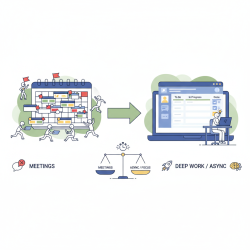
- Challenge the necessity of every meeting. Can the discussion happen asynchronously?
Leveraging Asynchronous Communication Effectively: Tools like Slack, Teams, or project management platforms are powerful, but can also become noisy. Encourage short, direct messages. If a topic requires more than three back-and-forth messages to resolve, it's likely better suited for a quick call or a scheduled meeting with a clear agenda. Use threads for related discussions to keep channels clean.
Examples of Good vs. Bad Communication
Let's illustrate the difference with practical examples relevant to a Software Engineering Manager's daily life.
Bad Communication Example:
Email Subject: Quick question about the new feature
"Hey Team, I was looking at the new feature we released last week, and I had some thoughts. Can someone get back to me on how it's performing? Also, thinking about next steps. Let me know."
This message is vague. Which new feature? What thoughts? What specific performance metrics are needed? "Next steps" for what? This will undoubtedly lead to multiple follow-up emails asking for clarification, wasting time for everyone involved.
Good Communication Example:
Email Subject: Action Required: Performance metrics for User Onboarding Flow (v2.1) by EOD Friday
"Hi [Developer/Team Lead Name], Could you please provide the following performance metrics for the User Onboarding Flow (version 2.1, deployed last Tuesday) by EOD Friday? Specifically, I need:
- Completion rate (new users completing registration)
- Average time spent on step 3 (email verification)
- Any error rates reported for this flow in the last 48 hours
This data is needed for our Q3 planning meeting next Monday. Please reply directly to this email with the numbers. Thanks!"
This good example is specific, sets clear expectations, provides context (why the data is needed), defines the format of the response, and includes a deadline. It anticipates potential questions and minimizes back-and-forth.
Cultivating a Culture of Communication Efficiency
As a manager, you are the primary role model for communication within your team. Lead by example by consistently applying these principles. Provide constructive feedback when communication can be improved, focusing on the impact of clarity rather than personal style. Empower team members to ask clarifying questions without fear of judgment. Encourage the use of templates for common communications, such as bug reports or feature requests, to ensure all necessary information is captured upfront. Regular retrospectives should include discussions about communication effectiveness and identify areas for improvement. A team that communicates efficiently is a team that delivers faster and with less friction.
Conclusion
Improving communication habits and styles is a continuous journey, but one with immense payoffs for Software Engineering Managers. By embracing clarity, conciseness, audience awareness, and strategic medium selection, managers can significantly reduce wasted time, minimize confusion, and foster a more productive and engaged team. The investment in refining these skills translates directly into faster project delivery, higher quality outcomes, and a more streamlined operational environment. Make efficient communication a cornerstone of your management philosophy, and watch your team's velocity and collaboration soar.
Comprehension questions
 Why is efficient communication particularly critical for Software Engineering Managers?Describe an example of What are three strategies mentioned for achieving faster and more to-the-point communication?How can a Software Engineering Manager cultivate a culture of efficient communication within their team?
Review Quiz
Next Lesson

Course Contents : Improving Time Management for Engineering Managers
- >> 7.
 Streamlining Communication to Increase Efficiency